Impetro Gear
From cardboard prototypes to acquisition. Founder and Product Lead.
The Problem and Hypothesis
As a multi-sport athlete (skiing, MTB, climbing), I noticed a friction point. Outdoor gear is often emotional — athletes collect skis and jackets — but backpacks are purely functional clutter.
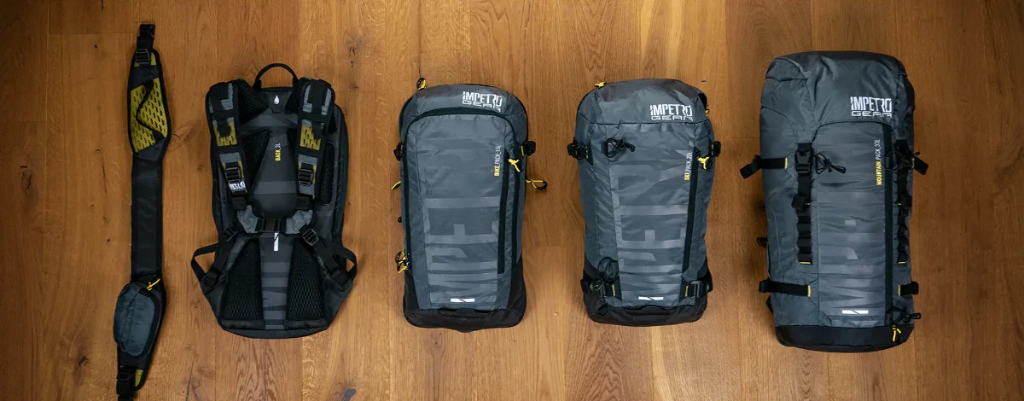
The insight: an underserved segment of "Pragmatists" who valued efficiency, storage space, and cost-savings over the status of owning multiple specialized bags. The value prop: one ergonomic base unit plus specific zip-on skins for different sports. Reduce waste, save space, save money.
I had to move past my own bias ('I want this') to validate that a market segment actually existed that prioritized utility over the status of owning multiple specialized bags.
Product Strategy: Trade-offs and the Kill List
We started with cardboard, tape, and webbing to validate ergonomics before aesthetics. Moving to production required ruthless prioritization.
What we killed: Nylon Ripstop with Kevlar reinforcements. We loved it. We killed it. Engineering overkill that would have destroyed margins without adding tangible value for the core user.
What we kept: A complex back system (frame and foam) arguably too advanced for V1. Removing it required re-tooling and a months-long delay. We kept the sunk cost.
Sometimes you cut a feature to save money (Kevlar), and sometimes you keep a complex feature to save time (back system). The difference is which direction preserves the business.
Commercial Strategy: The Pricing Trap
We launched on Kickstarter in November 2019, hit our public funding goal, and missed our internal financial targets. A post-mortem revealed the problem: we ran A/B tests to generate leads but never displayed the price. We built a mailing list of deal-seekers, then launched a high-end technical product at them.
At our MOQ of 500 units, the unit economics were too thin to sustain the business long-term compared to the 1,500+ volume we needed.
We optimized for sign-ups rather than qualified leads. Price transparency is a qualification tool, not just a checkout detail. Showing the price early would have built a smaller list of people who actually had the money to buy.
Operations: The Crisis and the Fix
Production ran January–April 2020. COVID hit. Shipping costs spiked 10x, travel restrictions prevented on-site QC in Vietnam. When the bags arrived in Austria, the main carry handle was not sewn to spec.
Two options: fix cheaply in Austria (risky quality) or air-freight back to Vietnam (expensive and slow). We chose brand equity over short-term savings. The entire stock went back to Vietnam for factory-certified repairs.
The root cause was a lack of verifiable remote testing protocols. I learned to build systems of verification rather than relying on trust — a lesson that applies equally to code deployment and bug bashing.
Turnaround and Exit
By late 2020 we were cash-poor but inventory-rich. A technical review with MTB-News.de validated the product and drove Black Friday sales that cleared six months of inventory in weeks and got us to break-even.
Facing a capital-intensive Round 2 that would require significant new debt, we analyzed the risk/reward ratio and sold the brand assets via Shopify Exchange in 2021. Knowing when to sell is as important as knowing when to build.
We exited to owners who could fund the next stage of growth. The alternative was taking on debt for a volume bet in a supply chain still recovering from COVID. That's not a product decision; it's a financial one.
What carried forward
Building Impetro was a masterclass in ownership. Whether you're shipping backpacks or software, the core principles don't change: validate early, watch your unit economics, build systems that scale.
Managing physical inventory taught me the pain of slow iteration cycles — six months to fix a handle. Software is faster. AI is faster still. The instinct to ship early, learn, and adjust came directly from this.